Number stations are a strange type of unattributed shortwave radio broadcast found outside the ‘fixed station’ bands, which transmit strings of numbers that are read in four or five digit sequences or registered in morse code or sequences of polytones. For decades radio enthusiasts have documented these radio events and catalogued their appearance through informal groups who share data to try and deduce the broadcasts' patterns and origins. The refusal of governments and radio licensing agencies to acknowledge their existence, plus fragments of evidence found in autobiographies, state intelligence files and the claims of cryptographers, seem to prove the theory that these are coded messages sent to espionage agents in foreign lands. All the spy needs is a portable and inconspicuous receiver, and some means of knowing when to listen and what the cipher is. These broadcasts can be freely heard by anyone with the patience to listen, and identify themselves through patterns of voice type, language type, frequency, time of broadcast and call signal. They publish perfectly sensible strings of known signs but to unknown effect.
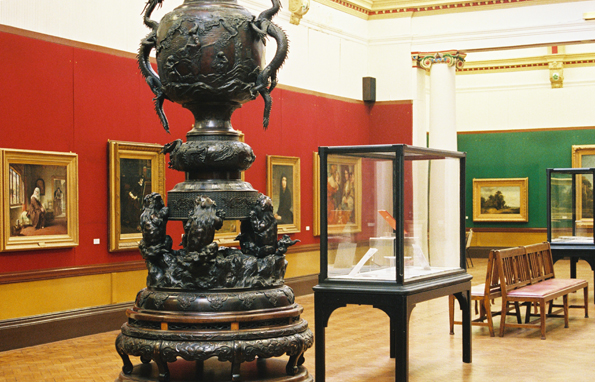
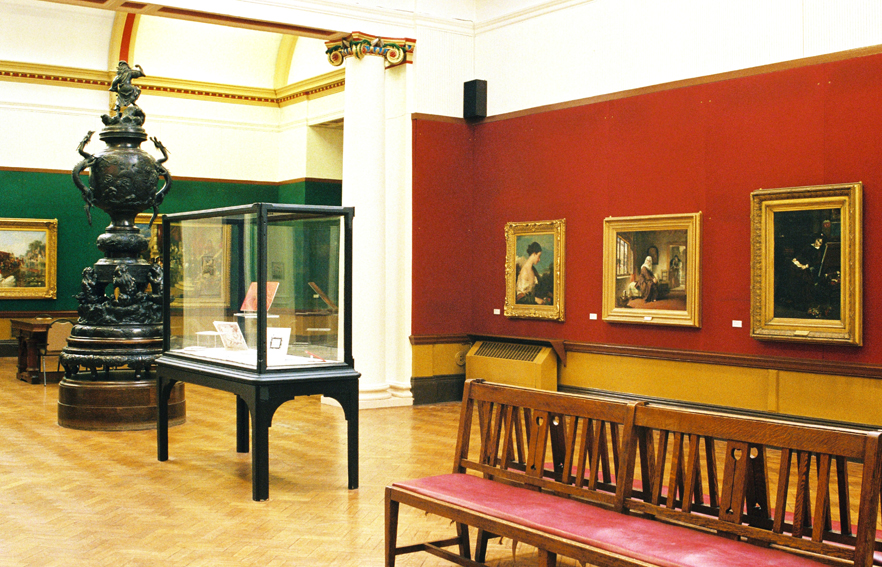
The title of The Enigma Variations triangulates the semiology of these messages, the Enigma Listening Group whose invaluable contributions enabled my project, and the mystery of the ‘unheard’ second code in the eponymous orchestral variations by English Romantic composer Edward Elgar. the result was a months-loing audio installation in the main hall of Bury City Museum’s painting collection.
Four corner-mounted loudspeakers relay a concealed backend of ten overlaid sound channels. Each channel is outputted from a constantly playing iPod, set to shuffle and endlessly reorder its playlist. Each playlist holds an archive of recordings from one or several number station(s) plus silences of varying lengths. The broadcasts represent a texture of languages and message-forms recorded as recently as April 2009, in Arabic, English, Farsi, German, Russian, Slovakian and Spanish tongues, plus polytone sequences.
Formally reduced to a sound signal and set amongst an Edwardian museal idyll of romantic and neo-classicist figurative art, The Enigma Variations blurts into the discourse of the hall just as number stations do through the interference of the radio waves. The simple audio devices self-determine when they ‘speak’, and the equalisation system opens them on to one another to interfere as a chorus, of nothing or everything, according to their own compositional logic.
Such messages have been poetically re-imagined before – by Cègeste and Orpheus in the second film of Jean Cocteau’s trilogy which retells the Greek myth; or by the International Necronautical Society’s appropriation of public information. In the Bury Text Festival, they take up the political narrative of the modernist fascination with the cryptogram (Edgar Allan Poe or Jorge Louis Borges, for example) and the appropriative interest in recontextualising data (theh Concrete interest in the shipping forecast or Dan Graham's magazine pages, for example).
A sample recorded live at the museum can be played below.
This work was commisisoned by Tony Trehy for Bury City Art Gallery for its annual Text Festival, the 2009 edition of which was called 'Signs of the Time'.