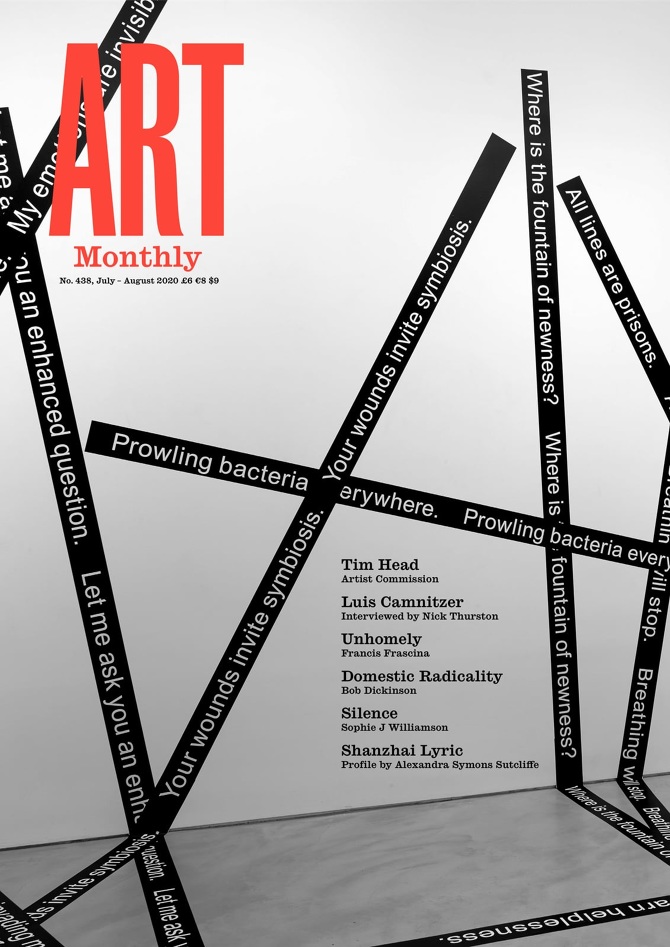
Published in the July-August 2020 issue of Art Monthly magazine, this lengthy interview with German-born, Uruguayan artist Luis Camnitzer orbits his constellation of thoughts on art, art education, and activism in the context of his collected essays on the topic, One Number is Worth One Word.
An excerpt from the interview:
Nick Thurston: Do you think there is any special connection between conceptualism and what you call "art’s main strengths – speculation, imagination, and its questions of 'what if ?'"?
Luis Camnitzer: I never liked the term 'Conceptual Art'. It both became recognised as a style and also inclined artists to look for some absolute essence of art. Unknowingly, it became a mystical quest, one often formalised on grid paper.
But conceptualism covered the idea of strategy and political action, and liberated us from predetermined visual results. The formal rule was minimum input for maximum output. It was informed by a poverty of resources and the need for consciousness-raising and empowerment. It forced us to deal with problem solving and the viewing – or view – of art, which became the basis for an all-encompassing approach by which one negotiates with reality to see what is possible and what is not.
This is what I later called ‘art thinking’. Its process identifies obstacles to the full implementation of the concept: why certain obstacles are there, who put them there and what interests they serve. It was practical and political. This mode of problem-oriented thinking in art started six decades ago and produced an irreversible rupture in how we look at art. It introduced problematisation as a general condition. So, today, when we look at any work of the past and go beyond hedonism, we ask, or should ask: What problem is that piece solving? Is the problem interesting to us, and is this work the best solution? Posing and answering these questions are entangled with the imagination and bound by the present. Problematisation breaks from knowledge of the past. The artwork becomes a shared platform for asking the unknown.
That is why I believe that the history of art should be taught from the perspective of the present onto the past, and not as a nice linear chronology based on narratives of cause and effect. Unfortunately, I could never find an art historian willing to really teach it that way.