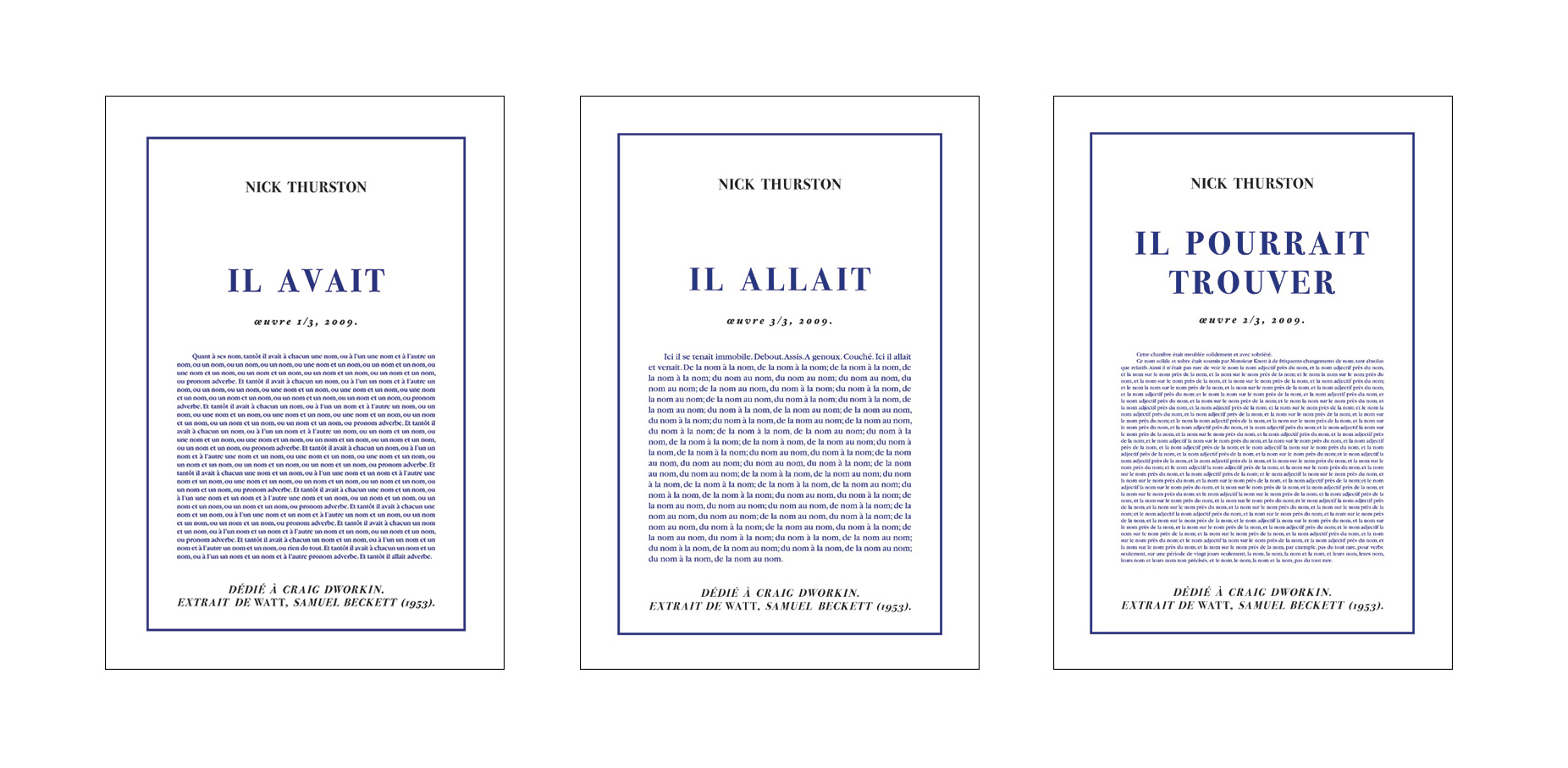
This series of fine prints invokes the last novel that Samuel Beckett wrote in English, Watt. The literary manoeuvres Beckett explores in that book find what he himself called, an “unsatisfactory” fictive embodiment in its narrative. But his displacement of conventional novelistic priorities allows the book to operate as an exercise in form and a formal play with classic modernist themes (i.e. rationalism, negation, etc.). Among its most distinct motifs are the long lists of choices faced by the main character, Mr. Watt. The scale and structural repetitiveness of these lists present hyper-exaggerated combinations of choices by reducing each option to a permutative unit held between a tightly strung syntactical pattern:
“Quant à ses pieds, tantôt il avait à chacun une chaussette, ou à l’un une chassu- sette et à l’autre un bas, ou un brodequin, ou un soulier, ou un chausson, ou une chaussette et un brodequin, ou un chaussette et un soulier, ou une chaussette et un chausson, ou un bas et un brodequin, ou un bas et un soulier, ou un bas et un chausson, ou rien du tout. Et tantôt il avait à chacun un bas, ou à l’un un bas et à l’autre un brodequin, ou un soulier, ou un chausson, ou une chaussette et un brodequin, ou une chaussette et un soulier, ou une chaussette et un chausson, ou un bas et un brodequin, ou un bas et un soulier, ou un bas et un chausson, ou rien du tout ... ”
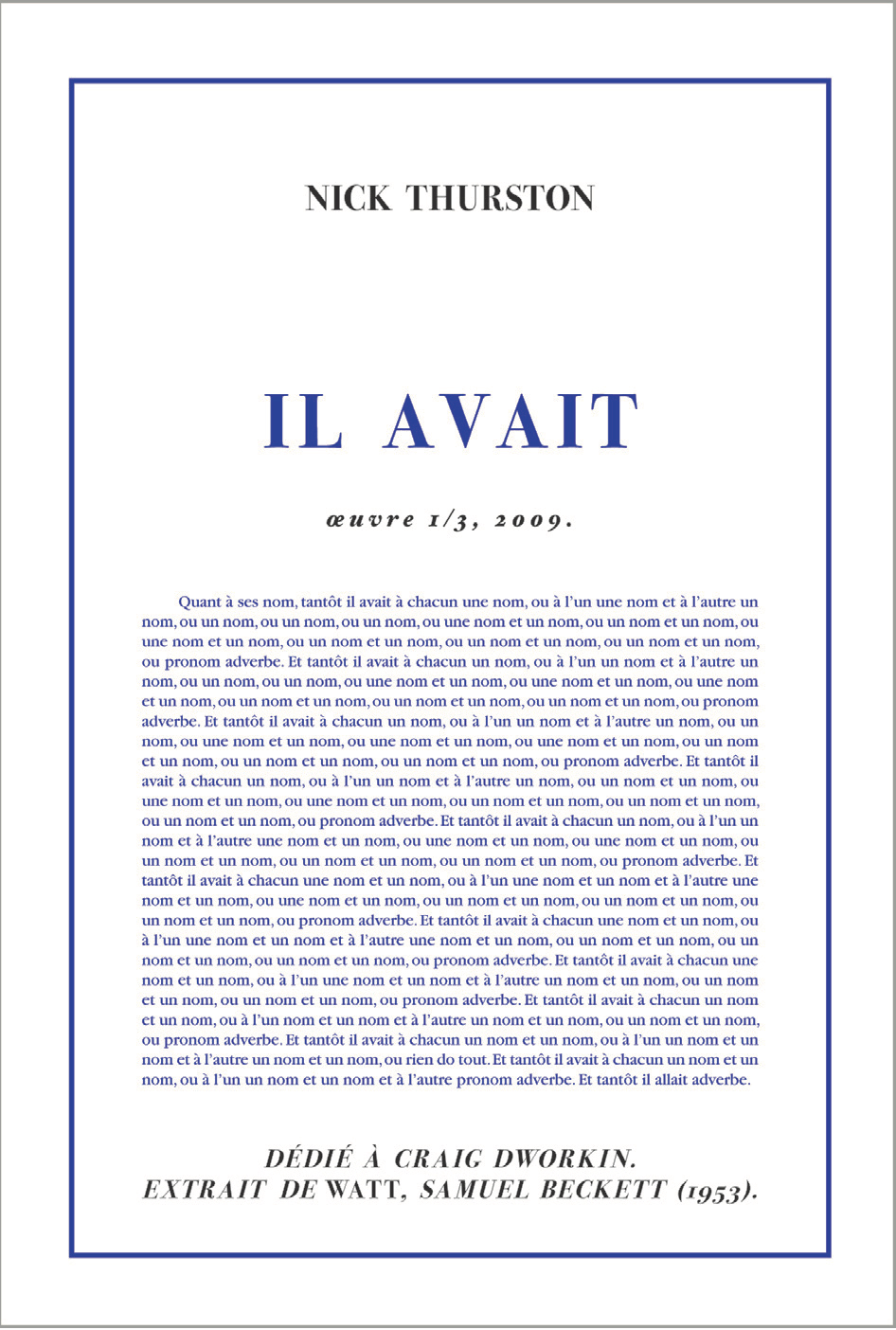
Mr. Watt is the consistent ‘Il’ through my series. Each of my three prints intervenes in one directly quoted list from from the French language version of Watt, whose translation by Ludovic and Agnès Janvier was made in collaboration with Beckett himself and first published in 1968. Using shallow parsing – a technique of linguistic analysis – I reduce the language tokens that represent the possible choices implicated by three simple actions (wearing, finding, and moving) to their grammatical function (as noun, adjective, etc.). The three resultant poems switch the reader’s attention to the slight nuances in Beckett’s connective patterns – the conjunctions, punctuation, etc:
“Quant à ses pieds, tantôt il avait à chacun un nom, ou à l’un un nom et à l’autre un nom, ou un nom, ou un nom, ou un nom, ou un nom et un nom, ou un nom et un nom, ou un nom et un nom, ou un nom et un nom, ou un nom et un nom, ou un nom et un nom, ou pronom adverbe. Et tantôt il avait à chacun un nom, ou à l’un un nom et à l’autre un nom, ou un nom, ou un nom, ou un nom et un nom, ou un nom et un nom, ou un nom et un nom, ou un nom et un nom, ou un nom et un nom, ou un nom et un nom, ou pronom adverbe ... ”
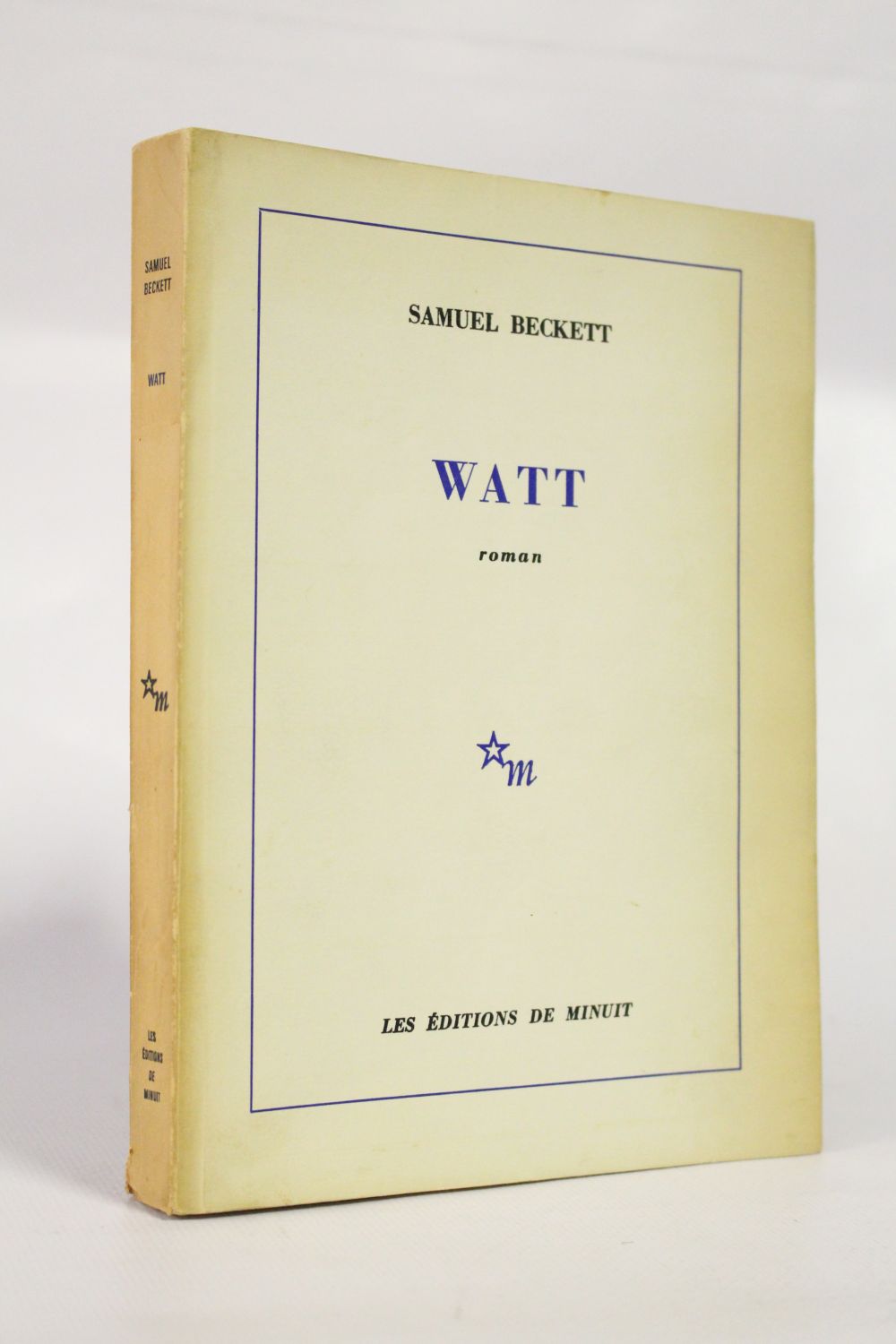
The uniform layout of these prints 'undesigns' the iconic book cover of the first French language edition of Watt, appropriating the layout, font set, and colour scheme made famous by Les Éditions de Minuit.
The edition were launched with a reading at the Small Publishers Fair, London, 2010.